Reading the Bible With the Founding Fathers
American University professor Daniel Dreisbach is probably the foremost expert on religion in the American founding era and a devoted student of the Bible, so he'southward arguably the best person to write a book on the Bible'due south employ during that period. Indeed, Reading the Bible with the Founding Fathers is a tour de force of scholarly research.
Dreisbach produces hundreds, perhaps thousands, of clear or subtle references to Bible verses by public persons in America between 1760 and 1800. His goal is to demonstrate that "the Bible was important to the social, legal, and political thought of the founding generation and a vital influence on the culture in which they lived" (6). His other stated goal is to "combine credible historical research and careful textual analysis with basic biblical scholarship and political theory" (16).
In the "Introduction" and the "Afterword," Dreisbach establishes some important caveats. Kickoff, the founding generation "drew on multiple sources" of influence, and the Bible didn't necessarily supervene upon the rest. 2d, a founder's utilise of the Bible "does not bespeak whether he or she was a Christian or a skeptic," as both used the Bible for their own purposes. Third, a merits of biblical influence "does not suggest that the founders were theocrats intent on imposing a biblical guild." Quaternary, the "mere fact that the founding generation ofttimes quoted from and alluded to the Bible reveals little about the American founding or the Bible'southward influence on tardily 18th-century political thought, except that the Bible was a familiar and useful literary source."
In low-cal of these cautionary notes, Dreisbach warns against a "mere quantitative accounting of biblical references" and emphasizes the need to "be circumspect to the purposes for which biblical texts were invoked," the historical context of their use, the biblical context of passages, and the proper interpretation of verses (half-dozen–8). All of these are valuable and crucial insights to remember when reading this book or 1 like it.
Interpreting the Patriots' Interpretations
Dreisbach demonstrates the ubiquitous presence of the Bible in the discourse of the 24-hour interval. He makes a decided effort to provide biblical context for verses and to lay "traditional" or "conventional" (i.e., literal) interpretations aslope those devised and employed past the founding generation. He does the latter with mixed success. Sometimes he brings the original Hebrew or Greek into his analysis; sometimes he doesn't. He devotes special sections to examine context and interpretation of certain passages; for others, he gives no such evaluation. For the nigh part, these special sections are quite good, although he fails to point out that passages from the book of Proverbs are proverbs—not God's promises, changeless rules, or "oaths of God" as the "patriots" took them (e.grand., 17, 174). Like the patriots, Dreisbach also tends to cite God'south covenants with and promises to his chosen people, Israel, as if they are universally applicative.
Dreisbach allots about 3 general paragraphs to the "conventional" (i.e., literal, directly) interpretation of Romans 13 and 1 Peter ii—passages that "on their face up" disallow resistance to authority and had been generally understood that way for more than 1,500 years. On the other hand, he devotes an unabridged chapter to a artistic interpretation favored by the American patriots and its historical—largely nonbiblical—genesis. Indeed, there's scarcely a word from the Bible for xx pages (116–135), only there's a lot of history and political theory. Dreisbach calls this interpretation—one that relies heavily on adding words and ideas to Romans 13—a "nuanced" interpretation, and commends the work of one of its creators for its "refreshing acquaintance with political thought in the Scripture" and presentation of a "cogent" theory (124). This would exist understandable in a generic report of the political thought of the founding generation, just it's problematic in a written report that specifically expresses concern for biblical context and proper interpretation of Scripture.
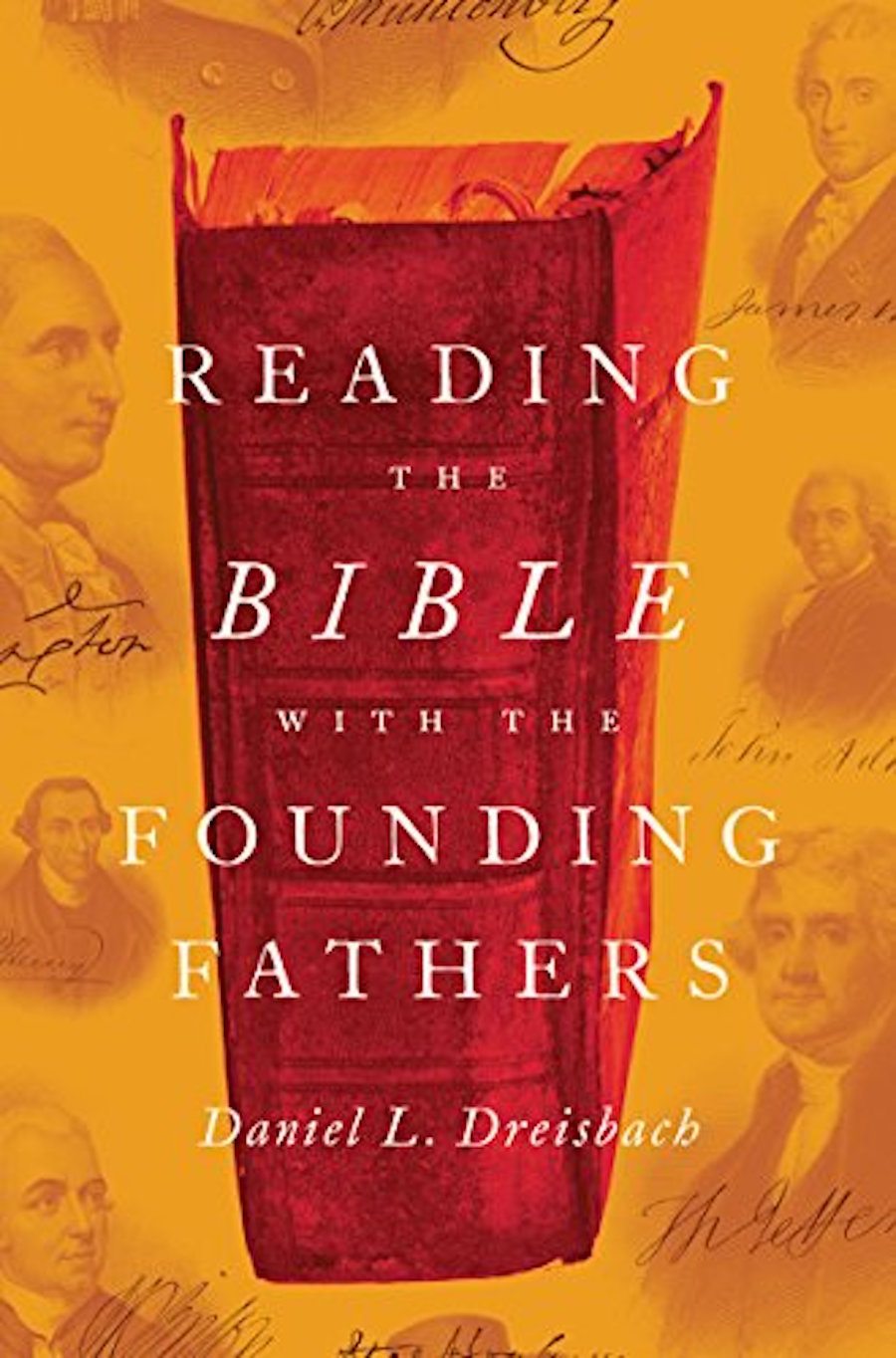
Reading the Bible with the Founding Fathers
Reading the Bible with the Founding Fathers
Daniel Dreisbach
Dreisbach apparently had to explain the interpretation of passages used to promote the American Revolution, but a truly biblical analysis of this issue would seem to crave addressing the issues and inconsistencies inherent in rejecting the literal, direct estimation in its historical and biblical context.
In the Easily of the 'Founders'
Another concern arises regarding Dreisbach's identification of some Bible utilize by the founding fathers. By his own account, his "expansive" definition of "founding fathers" includes "an unabridged generation or two of Americans" and "a cast of thousands" (12). One wonders who'southward not a founding father and, consequently, what significance is left to the term. Indeed, much of the Bible usage in Part II (the last 140 pages or so) is from preachers in sermons—not by actual revolutionary leaders or leading political figures creating the new nation'southward Constitution and institutions. With the exception of George Washington, few generally held to be "founding fathers" have more than a token presence in the book. A more appropriate title might be "Reading the Bible with the Founding Generation."
I critical question hangs over the volume: Did the Bible influence the "founding fathers," or did they simply notice ituseful for illustrating and bolstering their ain ideas gleaned from other sources? The Bible's use throughout the founding era, and particularly the revolutionary period, suggests the latter. For example, despite claims that the book of Deuteronomy and the case of the Hebrew commonwealth provided "principles, models, and precedents useful to them in the creation of their own polities," the framers didn't re-create the structures, institutions, or processes of that system (66). They simply sanctified their own novel and unprecedented system by claiming information technology followed a biblical example.
Despite these concerns,Reading the Bible with the Founding Fathers is a valuable cultural contribution. As long equally one applies Dreisbach's own cautionary notes in drawing conclusions, at that place'southward much to be learned. An attentive reader might find that biblical literacy was far more extensive in the founding era, which made both appropriate and inappropriate use of Scripture a powerful tactic of promoters of political causes. Since biblical stories and individual verses were, like today, meliorate known among the people than proper hermeneutical principles, abuse of the Bible often ran parallel to use of the Bible.
Reading the Bible with the Founding Fathersis a must-read for those interested in faith during the American founding flow, but read it with a critical eye.
Source: https://www.thegospelcoalition.org/reviews/reading-the-bible-with-the-founding-fathers/
0 Response to "Reading the Bible With the Founding Fathers"
Post a Comment